
Technical analysis (TA) is a methodology that evaluates cryptocurrencies by analyzing historical price data and market trends. It helps traders identify potential future price movements by understanding supply and demand dynamics. TA provides insights into possible trade entry and exit points, which is essential in the volatile crypto market. By utilizing tools like moving averages and RSI, traders can optimize their strategies. Exploring further can reveal more about mastering TA for effective trading.
Technical analysis (TA) serves as a significant tool for traders maneuvering the dynamic landscape of cryptocurrency markets. By examining historical price data, TA aims to identify trends and predict future price movements, focusing primarily on the relationship between supply, demand, and price action rather than an asset’s intrinsic value. It operates under the premise that price movements follow identifiable trends and that market history tends to repeat itself, allowing traders to capitalize on patterns that emerge over time.
At the core of technical analysis lies the belief that market prices reflect all available information, rendering price action the focal point for analysis. Established trends are assumed to have a higher likelihood of continuation rather than reversal, while human emotions driving market behaviors are consistent, leading to repetitive patterns. Traders often rely on statistical tools such as moving averages, trendlines, and the Relative Strength Index (RSI) as part of their analytical arsenal. These tools enable the evaluation of market conditions and help traders make informed decisions based on observable price movements. Additionally, understanding historical price movements is crucial for predicting future market behavior. New investors should also be aware of common mistakes that can undermine their trading efforts, such as neglecting risk management. By incorporating strategies like strong internal controls, traders can enhance their overall trading approach.
At the heart of technical analysis is the notion that price action encapsulates all market information, guiding traders through established trends and emotional patterns.
Moving averages, for instance, smooth out price data, aiding in the identification of trend directions and potential reversals. Trendlines visually depict support and resistance levels, offering insights into where price movements may stall or change direction. The RSI serves to measure momentum and identify overbought or oversold conditions, while volume analysis confirms the strength behind price movements, helping to validate trends. Additionally, chart patterns like triangles and head-and-shoulders assist traders in predicting breakout or reversal points, enhancing the predictive power of TA.
Unlike fundamental analysis, which evaluates long-term value determinants such as development teams and network activity, technical analysis strictly concentrates on price trends and market data. This distinction allows traders to derive actionable insights for short to medium-term trading decisions. While some traders may choose to combine TA with fundamental analysis for a more thorough market perspective, TA remains essential for timing market entries and exits.
In the volatile crypto market, where daily fluctuations can be influenced by online hype, TA proves invaluable. It helps traders distinguish strong trends from mere noise, enabling real-time trend analysis. Given that the cryptocurrency market operates 24/7, TA tools facilitate continuous monitoring, allowing traders to identify ideal trading windows amidst the prevalent volatility. Moreover, risk management is critical in trading, requiring constant monitoring of positions to protect investments.
Consequently, technical analysis stands as an essential strategy for those engaged in the fast-paced world of cryptocurrency trading.
Frequently Asked Questions
What Tools Are Essential for Performing Technical Analysis in Crypto?
Essential tools for performing technical analysis in crypto include charting platforms like TradingView and Coinigy, which offer various chart types and indicators.
Key technical indicators such as moving averages, RSI, and MACD help identify trends and momentum.
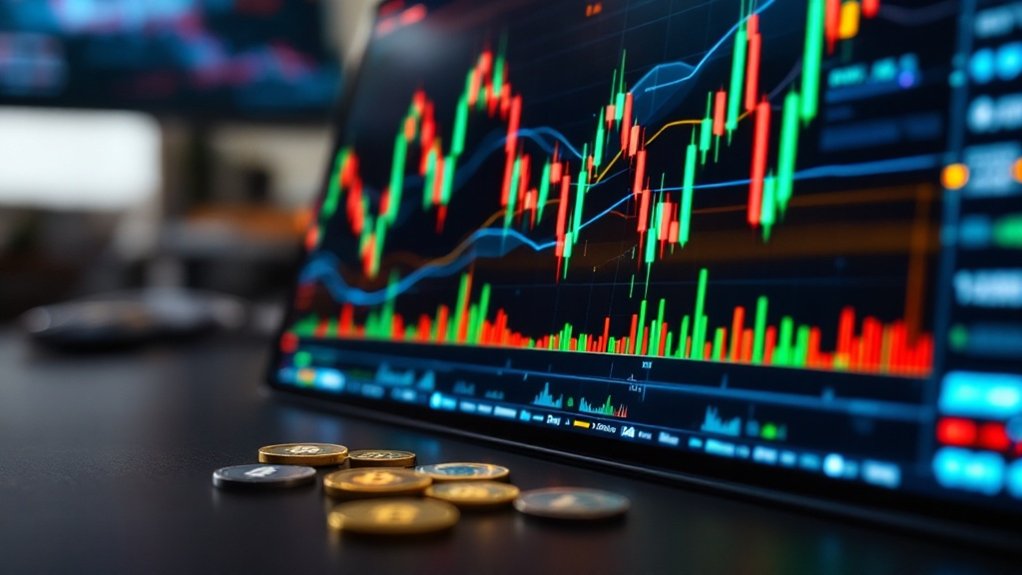
Candlestick charts are favored for visualizing price action, while volume profile charts assist in recognizing support and resistance levels.
Additionally, scripting tools allow for customization and automation, enhancing the analysis process for traders.
How Do News Events Impact Technical Analysis Predictions?
News events greatly impact technical analysis predictions by introducing volatility that can skew price patterns and trends.
Sudden geopolitical or regulatory announcements often lead to rapid price fluctuations, making historical data less reliable for forecasting.
Additionally, negative news sentiment can trigger price drops that deviate from established technical indicators.
Consequently, traders must integrate news sentiment analysis with technical tools to better anticipate short-term market movements amidst the inherent unpredictability of news-driven market reactions.
Can Beginners Effectively Use Technical Analysis in Crypto Trading?
Beginners can effectively use technical analysis in crypto trading, as it offers accessible tools and resources that facilitate learning.
Basic principles, such as chart reading and common indicators, are straightforward for novices to grasp.
However, they must navigate challenges like market volatility and emotional reactions, which can complicate their analysis.
Continuous practice and the incorporation of risk management strategies are essential for improving their skills and enhancing decision-making in the dynamic crypto landscape.
What Are Common Mistakes in Technical Analysis for Cryptocurrencies?
Common mistakes in technical analysis for cryptocurrencies include over-reliance on single indicators, neglecting broader market context, and emotional trading.
Traders often misinterpret candlestick patterns without considering confirmation from other indicators or market trends. Additionally, impulsive decisions driven by fear or excitement can lead to significant losses.
Failing to implement proper risk management strategies, such as setting stop-loss orders, further compounds these issues, reducing overall trading effectiveness and increasing risk exposure.
How Often Should I Update My Technical Analysis Charts?
The frequency of updating technical analysis charts should align with a trader’s style and the market’s volatility.
Short-term traders may update charts every 5 to 15 minutes, while swing traders typically refresh them every few hours to a day.
Long-term traders might only need daily or weekly updates.
Additionally, during periods of high volatility or significant market events, traders should be prepared to reassess their charts more frequently to make informed decisions.