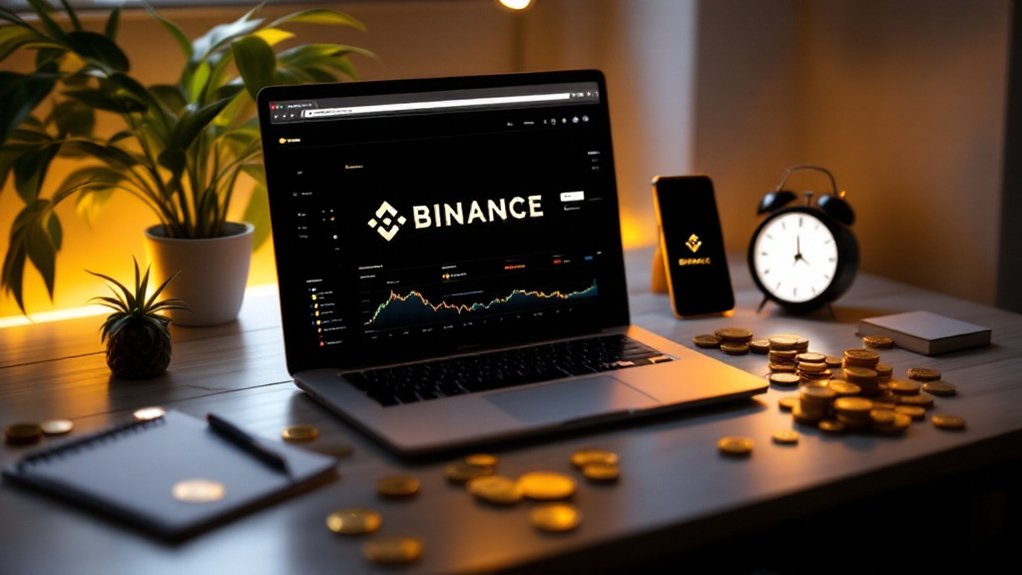
To use Binance effectively, beginners should start by creating an account with a valid email or phone number and a strong password. Enable two-factor authentication for added security. After completing the KYC process, users can deposit funds via bank transfer or credit card. The intuitive interface allows access to various trading options, including Spot and Futures Trading. Understanding order types enhances trading strategies. Learning more about these features will help maximize the trading experience.
Steering through the world of cryptocurrency trading can be intimidating, but Binance offers a user-friendly platform that simplifies the process. To get started, users must first create an account by accessing the Binance platform through its official website or mobile app, available for both iOS and Android. Registration requires a valid email or phone number, followed by setting a strong password.
To enhance security, enabling two-factor authentication (2FA) via Google Authenticator or SMS is highly recommended. Completing the Know Your Customer (KYC) process is necessary for full access to deposit, withdrawal, and trading features, necessitating the submission of a government-issued ID and a selfie for verification.
Once the account is set up, users can deposit funds. They can choose to deposit fiat currency using bank transfers, credit or debit cards, or peer-to-peer trading options such as Easypaisa or JazzCash, where applicable. For those looking to deposit cryptocurrencies, transferring from an external wallet to the designated Binance wallet address is straightforward. Fiat Deposits allow users to easily fund their accounts for trading activities. Binance supports multiple fiat payment methods to cater to a diverse user base. Choosing the right exchange can significantly impact your trading experience, making it essential to select a platform that meets your needs. Additionally, new users should prioritize thorough research to better understand the assets they intend to invest in.
Care should be taken in selecting the preferred coin and blockchain network to avoid potential losses, and beginners are advised to start with smaller deposit amounts to familiarize themselves with the process.
Navigating the Binance interface is intuitive. The “Trade” menu provides access to both Spot and Futures Trading. The Spot Trading interface displays order books, price charts, and controls for order placement, with options for “Classic” or “Advanced” views based on user experience. A search function helps in finding trading pairs by base assets such as BTC, ETH, or USDT.
The wallet section conveniently shows fiat and spot balances, along with deposit and withdrawal options.
The wallet section provides easy access to your fiat and spot balances, along with seamless deposit and withdrawal options.
For beginners, understanding spot trading basics is vital. This involves the immediate buying or selling of cryptocurrencies at current market prices, utilizing various order types including Market, Limit, and Stop-Limit orders. Market orders execute instantly, while Limit orders only activate when the market reaches a specified price.
Stop-Limit orders are beneficial for implementing stop-loss or take-profit strategies.
Advanced trading features like futures trading and margin trading allow for leveraged positions, albeit with higher associated risks. Trading bots and copy trading options can assist users in optimizing their strategies.
Security remains paramount, with strong password management, 2FA, and regular security reviews recommended to protect accounts against phishing and unauthorized access. Withdrawals require additional verification steps to safeguard funds.
Binance’s competitive fees, which adjust monthly based on trading volume and BNB holdings, further enhance the user experience, making it a compelling choice for both novice and experienced traders.
Frequently Asked Questions
What Is the Minimum Deposit Required to Start Trading on Binance?
The minimum deposit required to start trading on Binance is technically nonexistent, as there is no minimum deposit amount to open an account.
However, users must consider that the minimum trade size is $5. Various deposit methods, such as P2P, may have minimums around $10, while cryptocurrency deposits can be as low as 0.00000001 BTC.
Users should also account for potential fees imposed by payment providers, depending on the chosen method.
How Can I Recover a Lost Binance Account?
To recover a lost Binance account, the individual should start by using the ‘Forgot your password?’ option for password recovery.
If access is still available, enabling the ‘Freeze Account’ feature is advisable.
For users unable to access linked phone or email, submitting an appeal with a valid ID, a statement video, and following all verification guidelines is essential.
Resetting two-factor authentication should also be prioritized to secure the account.
Are There Any Withdrawal Limits on Binance Accounts?
Yes, there are withdrawal limits on Binance accounts that vary based on verification levels.
Non-KYC accounts can withdraw up to 0.6 BTC daily, while those who complete KYC verification can withdraw up to 100 BTC equivalent daily.
Additionally, Binance’s C2C platform features T+1 withdrawal plans, and fiat withdrawals require full KYC verification.
Binance.US users have specific limits for ACH and bank wire withdrawals, with daily limits reaching up to $1,000,000.
Is Binance Available in My Country?
Binance’s availability varies considerably by region. In over 100 countries, users can access its services, with full support in many South American, African, Asian, and European nations.
However, futures trading faces restrictions in North America, much of Europe, and parts of Asia and the Middle East. To determine availability in a specific country, individuals can visit the Binance Futures website and attempt to place an order, checking for any restrictions.
What Fees Does Binance Charge for Trading and Withdrawals?
Binance charges a default trading fee of 0.10% for both makers and takers on spot trades.
For futures, fees vary by contract type, with USDT-margined contracts at 0.02% maker and 0.05% taker fees, while USDC-margined contracts offer a 0% maker fee and 0.04% taker fee.
Withdrawal fees are dynamic, influenced by cryptocurrency type and network conditions, requiring users to account for standard network gas fees as well.