In 2025, the top five crypto wallets prioritize security and ease of use, reflecting the evolving landscape of digital assets. Hardware wallets utilize advanced features like Secure Element chips and tamper-evident seals, ensuring maximum protection. Mobile wallets offer user-friendly interfaces and non-custodial options, allowing users to manage private keys. Cold storage solutions enhance security further by keeping assets offline. These wallets cater to diverse user needs, making them essential choices for investors. There is much more to explore in this space.
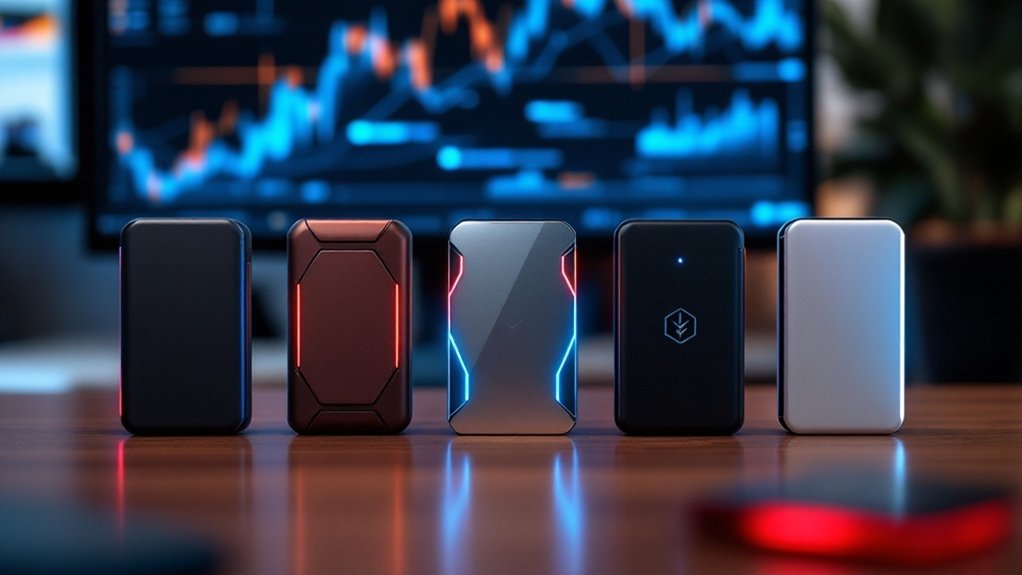
As digital currencies gain popularity, selecting the right crypto wallet becomes essential for both security and user convenience. The landscape of crypto wallets has evolved remarkably, with various options catering to different user needs, particularly focusing on security features and usability. Among these, hardware wallets stand out due to their advanced security measures. Many of these wallets utilize Secure Element (SE) chips rated EAL6+, designed to withstand physical tampering and brute-force attacks.
Additionally, tamper-evident seals on packaging guarantee the integrity of the wallet before initial use, providing an extra layer of security for users. Open-source firmware and wallet software allow for community auditing, fostering transparency and trust among users. With support for multi-coin compatibility, these hardware wallets can manage from over 1,000 to upwards of 10,000 cryptocurrencies, making them a versatile choice for diverse portfolios. Increased security measures ensure that serious investors can safely store their assets while enjoying peace of mind.
Tamper-evident seals and open-source software enhance wallet security and transparency while supporting thousands of cryptocurrencies for versatile portfolio management.
Mobile wallets have also gained traction, balancing security with user convenience. These wallets support extensive blockchain networks, often accommodating over 100 blockchains and millions of assets. With non-custodial models, users maintain complete control over their private keys, eliminating the need for KYC requirements during setup.
Many mobile wallets integrate additional features such as staking, swapping, and access to decentralized finance (DeFi), enhancing their usability. Moreover, compatibility with hardware wallets allows for the integration of cold storage, marrying the benefits of hot and cold wallets for peak security.
Open-source wallets attract security-focused users due to their transparent nature, allowing for ongoing improvements and vulnerability detection by the community. These wallets often provide features like passphrase protection and Shamir backup for enhanced recovery options. Some top models also facilitate compatibility with third-party applications, including popular interfaces like MetaMask and various DeFi platforms.
Cold storage wallets offer considerable advantages by keeping crypto assets offline, thereby reducing exposure to hacks and malware. Many hardware wallets incorporate biometric security and tamper-proof casings for secure usage on the go. With options for seed phrase and metal plate backups, these devices effectively protect against loss or physical damage while supporting extensive cryptocurrency storage.
Ease of use remains a critical factor in wallet selection. Many top wallets feature user-friendly interfaces across multiple platforms, including mobile and desktop. Built-in asset swapping allows for in-app exchanges without relying on external platforms, while some wallets now provide integrated crypto spend cards for direct transactions.
Backup systems, incorporating mnemonic seed phrases and Shamir Secret Sharing, further enhance user experience and security, guaranteeing that privacy remains paramount in wallet setup.
Frequently Asked Questions
Which Wallets Support Multiple Cryptocurrencies Effectively?
Several wallets effectively support multiple cryptocurrencies.
Exodus offers a user-friendly platform for managing thousands of coins, while Trust Wallet excels in multi-chain capabilities.
Best Wallet app also facilitates extensive token management across various blockchains.
MetaMask integrates seamlessly with Ethereum and Polygon, supporting diverse Web3 assets.
For hardware options, Ledger Nano X and Trezor Model T provide secure multi-asset management, accommodating numerous cryptocurrencies through integration with various wallet applications.
How Do I Recover a Lost Wallet Password?
To recover a lost wallet password, one must first check if a recovery phrase is available.
If it is, the wallet can typically be restored by importing this phrase into a new device.
For custodial wallets, password reset options may involve email or identity verification.
In cases where neither the password nor recovery phrase is accessible, professional recovery services or specialized software tools may offer assistance, though success is not guaranteed.
Prompt action is essential.
Can I Use a Crypto Wallet Without Internet Access?
Yes, a crypto wallet can be used without internet access. Offline wallets, or cold wallets, securely store private keys without connecting to the internet, making them immune to online threats.
Users can conduct transactions by signing them offline and later broadcasting them through an internet-connected device.
While this method enhances security, it requires additional steps, making it less convenient for frequent trading but ideal for long-term storage of crypto assets.
What Fees Are Associated With Different Wallets?
Various crypto wallets come with distinct fee structures.
For instance, Exodus charges no fees for sending or receiving crypto, only the network fees. Coinbase, on the other hand, has free deposits but high withdrawal fees.
Dash and Solana offer very low transaction fees.
Built-in exchanges within wallets like Exodus and Coinbase impose spreads and conversion fees. Additionally, users may face withdrawal and network fees, impacting overall transaction costs considerably.
Are There Wallets Specifically for Beginners?
Yes, there are wallets specifically designed for beginners.
These wallets prioritize user-friendliness and security, often eliminating complex seed phrases. For instance, Zengo offers a keyless model with 24/7 support, while Tangem provides a straightforward setup and hidden private keys.
Software options like Coinbase and Exodus are also popular due to their intuitive interfaces.
Many beginner-friendly wallets incorporate biometric authentication and live support, ensuring a smoother onboarding experience for new users.