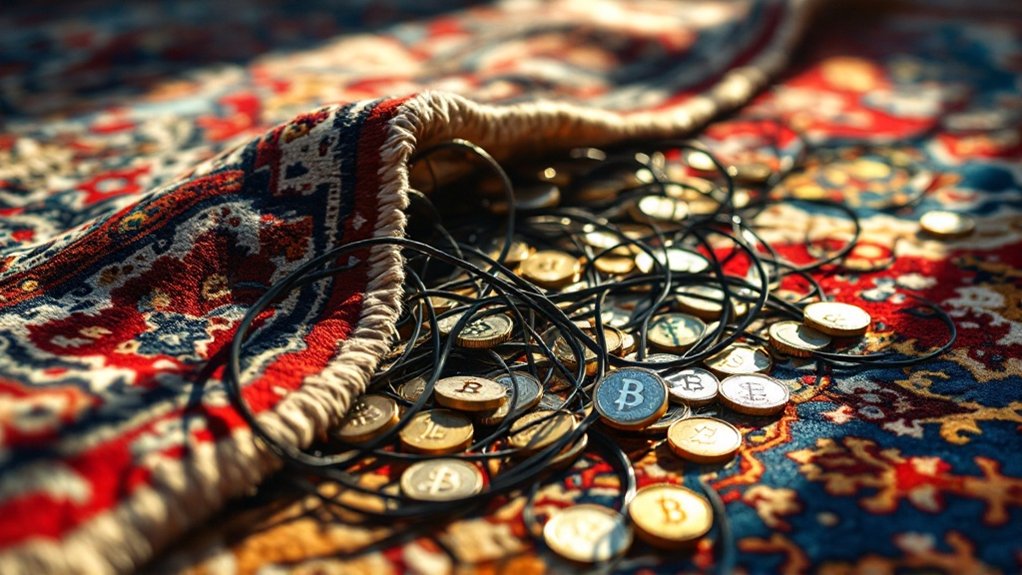
Rug pulls in cryptocurrency occur when developers abandon a token after generating hype, taking investors’ funds with them. These scams exploit trust and often utilize unregulated exchanges for funding. Signs of potential rug pulls include a high percentage of tokens held by the development team, lack of security audits, and aggressive marketing tactics. Investors should remain vigilant and conduct thorough research to identify red flags. More insights on recognizing and mitigating such risks await.
As the cryptocurrency market continues to evolve, rug pulls have emerged as a prevalent threat, targeting unsuspecting investors. Rug pulls occur when the creators of a new token, often operating anonymously, generate hype around their project and subsequently abandon it at peak value. In decentralized finance (DeFi) ecosystems, these malicious actors exploit the trust of investors, often listing their tokens on unregulated exchanges to attract funding. They typically employ aggressive marketing strategies, including endorsements from influencers and fake partnerships, to create a fear of missing out (FOMO) among potential buyers.
The mechanisms of rug pulls can be categorized into hard and soft strategies. Hard rug pulls involve the embedding of malicious code in smart contracts, enabling developers to steal funds or restrict sales, while soft rug pulls may not involve direct theft but rely on marketing hype until the project is abandoned. Additionally, many rug pulls occur due to exploitation of trust, where developers take advantage of investors’ confidence in the project. Furthermore, the absence of significant team-held tokens can reduce the risk of rug pulls and enhance the project’s credibility. Implementing strong internal controls can further safeguard against such risks. Understanding risk management is crucial for investors to navigate these threats effectively.
Another common tactic is the pump and dump scheme, where developers inflate the token price artificially, only to sell their holdings for profit later. Additionally, liquidity stealing and limiting sell orders are further strategies that can lead to significant losses for investors.
Several indicators can signal a potential rug pull. A rapid and extraordinary increase in token price, such as a 50X jump within a short timeframe, often suggests unsustainable hype and potential manipulation. Investors should also be wary of anonymous or poorly known development teams, particularly those lacking transparency.
A concerning proportion of tokens held by the team can facilitate an easy exit with substantial funds, further heightening the risk. In addition, aggressive marketing tactics, such as fake endorsements or mass promotions, raise red flags, as does the absence of security audits on the smart contracts involved.
The platforms most commonly exploited in these scams are decentralized exchanges (DEXs) like Uniswap and Pancakeswap, where tokens can be easily listed with minimal oversight. These environments allow for the rapid draining of liquidity pools if developers exploit loopholes in smart contracts.
The prevalence of bots and wash trading techniques can artificially simulate demand, further inflating token prices. As a result, the scale of rug pulls has grown alarmingly, with over 300,000 scam tokens created, defrauding millions of investors and causing significant erosion of trust in the crypto market.
Frequently Asked Questions
How Do Rug Pulls Affect the Overall Cryptocurrency Market?
Rug pulls severely impact the overall cryptocurrency market by eroding investor confidence and fostering skepticism.
Retail investors often bear the brunt of losses, leading to a cautious approach toward future investments. This heightened distrust results in reduced trading volumes and liquidity, particularly within decentralized finance (DeFi) sectors.
Additionally, the concentration of scams on major platforms exacerbates vulnerabilities, hindering market growth and innovation while contributing to a broader landscape of illegal crypto activities.
Are Rug Pulls Illegal in All Countries?
Rug pulls are not universally illegal, as their legality varies widely across jurisdictions.
In some places, such as New York, legislation is being introduced to explicitly criminalize such acts.
However, many countries lack specific laws targeting rug pulls, relying instead on existing fraud and consumer protection statutes.
Consequently, while hard rug pulls may often violate laws against theft and fraud, soft rug pulls may exist within legal gray areas, complicating enforcement.
What Are Some Common Tactics Used in Rug Pulls?
Common tactics used in rug pulls include creating fraudulent tokens paired with established cryptocurrencies, artificially inflating their value through heavy promotion, and then withdrawing liquidity at peak prices.
Additionally, developers may engage in pump-and-dump schemes, manipulating demand before selling off their holdings.
Smart contract manipulation can also restrict selling for investors, while social engineering tactics involve professional marketing to mislead potential buyers, ultimately resulting in financial loss when the developers vanish.
Can Rug Pulls Happen in Decentralized Finance (Defi) Projects?
Yes, rug pulls can occur in decentralized finance (DeFi) projects.
They often exploit the unregulated nature of DeFi, allowing developers to create tokens and attract investments through misleading marketing.
Once the token’s value peaks, developers may drain liquidity or vanish entirely.
The anonymity of project teams and the lack of oversight greatly heighten the risk of such scams, leading to sudden or gradual losses for unsuspecting investors.
How Can I Recover Funds Lost in a Rug Pull?
To recover funds lost in a rug pull, individuals can pursue legal action against the perpetrators, report incidents to regulatory authorities, and engage specialized legal counsel.
Monitoring blockchain transactions may help trace stolen funds, while recovery platforms and community-driven efforts can offer assistance.
However, success is often limited, especially if the fraudsters are anonymous or operate in unregulated areas.
Prompt reporting and thorough vetting of recovery services are essential for improving recovery chances.