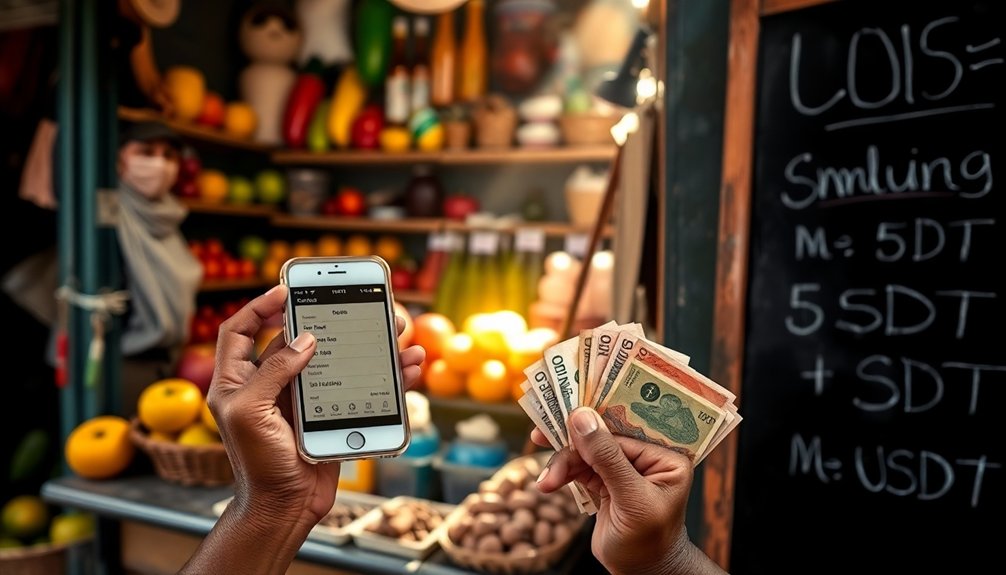

While traditional finance still struggles to connect the developing world, stablecoins have quietly revolutionized how billions of people interact with money. Monthly stablecoin transactions hit a staggering $1.25 trillion in September 2025. That’s not a typo. Real people are using these digital dollars on a massive scale, and banks are still scratching their heads wondering what happened.
The numbers don’t lie. Tether alone processed over $700 billion monthly, peaking at $1.01 trillion in June 2025. The total stablecoin market now exceeds $300 billion. Wall Street analysts predict it could hit $750 billion soon. Guess they finally noticed what’s happening.
Latin America leads this financial revolt. An impressive 71% of businesses there use stablecoins for cross-border payments. Why? Because they work. Sub-Saharan Africa isn’t far behind with 52% year-over-year growth. South and Southeast Asia have become adoption hotspots, with countries like Vietnam, India, and Pakistan embracing mobile crypto wallets at breakneck speed.
Argentinians and Colombians, tired of watching their pesos evaporate overnight, have turned to dollar-pegged stablecoins en masse. Multi-fold growth in three years. Not surprising when your national currency is worth less than the paper it’s printed on.
People aren’t just speculating. They’re using stablecoins for real stuff: sending money home without Western Union taking a cut, preserving savings against inflation, buying groceries, and paying employees across borders instantly. This growth aligns with the Global Crypto Adoption Index showing APAC region leads in grassroots crypto activity, with India, Pakistan, and Vietnam driving adoption.
Businesses love the real-time settlement. No more waiting days for international transfers to clear.
The infrastructure has matured rapidly too. By 2025, 86% of surveyed firms reported ready-to-use stablecoin systems. Even with Tether and USDC controlling 87% of the market (concentration risk, anyone?), people vote with their wallets. These two dominant stablecoins now account for over 1% of USD in circulation, showing their growing importance in the global financial ecosystem.
This isn’t just about technology. It’s about necessity. When traditional finance fails you, you find alternatives. These digital currencies serve as a critical store of value in regions where local currencies face extreme instability.
And millions across the Global South have found their answer in stablecoins. Banks and regulators can catch up or get left behind. The quiet revolution won’t wait.