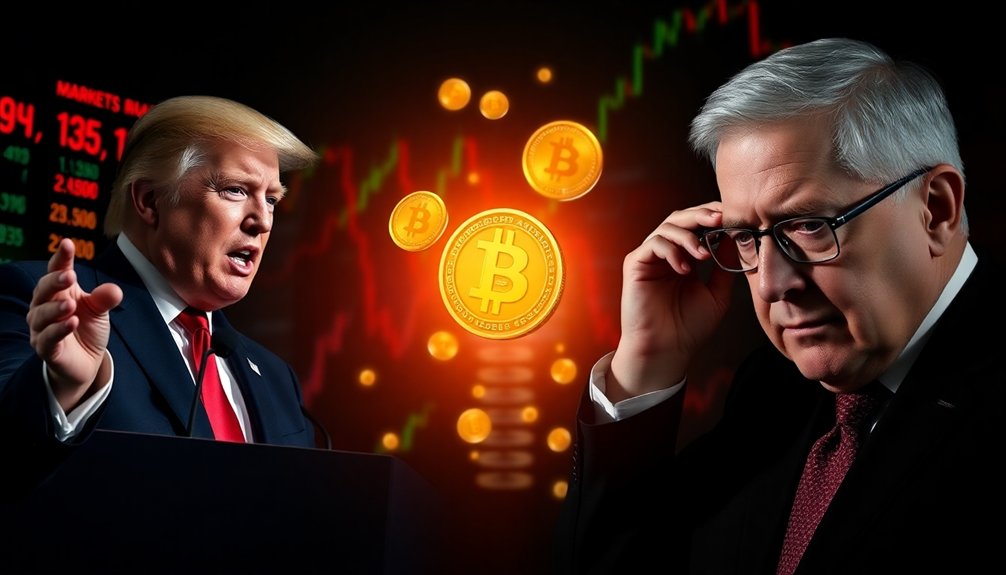

As the Federal Reserve finds itself embroiled in an unprecedented political saga, Bitcoin and gold have surged to new heights, reflecting growing market anxiety about central bank independence.
Fed Chair Jerome Powell‘s bombshell disclosure of a criminal investigation into a $2.5 billion renovation project has markets spooked—and not without reason. Powell didn’t mince words, calling the probe a “pretext” designed to pressure the Fed into cutting rates. Convenient timing, isn’t it?
The investigation emerges as Trump’s years-long campaign for deeper rate cuts finally appears to be gaining traction. Markets aren’t stupid. They see what’s happening. Gold exploded to record highs of $4,601 per ounce. Bitcoin touched $90,561 before pulling back slightly. Investors clearly prefer hard assets when central bank credibility comes under fire.
Wall Street banks are scrambling to adjust. JPMorgan Chase completely eliminated expectations for 2026 rate cuts. They’re now predicting a rate increase in 2027. Barclays and Morgan Stanley pushed their rate cut forecasts to mid-2026. Strong employment data gave them cover, but the Powell investigation is the elephant in the room.
The market implications are serious. Really serious. Every asset price on the planet assumes U.S. monetary policy follows economic data, not political pressure. That assumption is now in question. The dollar weakened against major currencies as traders digested the news. Silver followed gold higher. Bitcoin’s market dominance of approximately 62.7% explains why it often leads market responses during periods of economic uncertainty. December’s US inflation data will be crucial in determining the Fed’s next move amid this political turmoil. Financial markets hate uncertainty, and this saga delivers it in spades.
Technical analysts now see gold potentially reaching $4,685 before making a run at the big psychological level of $5,000. For Bitcoin, major support sits around $65,000 if consolidation occurs. The CME FedWatch tool indicates a 95% chance of rates holding steady in January.
The clash adds another layer to an already complex market picture. Fed independence has been sacrosanct in modern financial markets. That foundation looks shakier by the day.
Traders are pricing in a 95% chance rates stay put in January, but beyond that? All bets are off. Welcome to the new normal—politics and monetary policy in an uncomfortable embrace.