
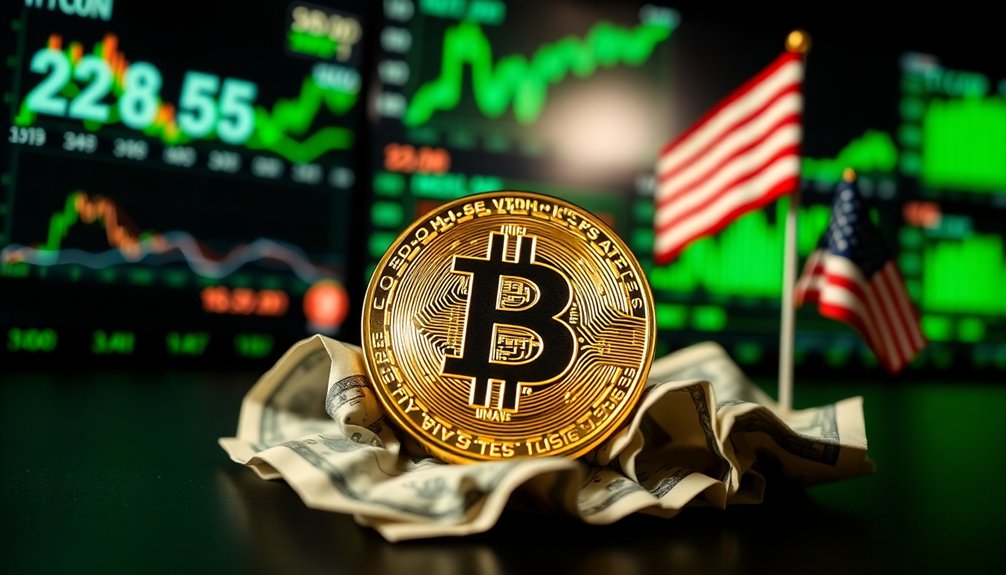
Turbulence has given way to tedium. Bitcoin’s price action has become almost boring in early 2026, stuck below $95,000 like a teenager grounded on prom night. The cryptocurrency that once gave investors heart palpitations now just oscillates between high-$80,000s and mid-$90,000s. Yawn.
After briefly flirting with $94,500 in January, Bitcoin retreated to a weekly low of $89,226. It closed at $90,505 on January 12th. Not exactly the moon shot that crypto bros promised on Twitter, is it?
Bitcoin’s January tease at $94,500 crashed to $89,226 before settling at $90,505—hardly the lunar landing promised by Twitter’s crypto evangelists.
This consolidation phase has defined 2026 so far. Macro uncertainty has everyone playing it safe. Bitcoin’s wild west days are fading as it enters a more mature price discovery phase. The market seems perfectly balanced – neither FOMO buying nor panic selling. Just steady, predictable, mind-numbing trading.
Volatility has plummeted to multi-year lows of around 27%. Remember when 80% drawdowns were normal? Now we’re looking at maybe 40%. Progress, sure, but boring progress. Bitcoin’s annualized volatility sits between 40-70%, similar to frontier equities. The predicted one-week volatility was just 39.44% on January 12th. Holders aren’t thrilled about the upside limitations.
Institutions are partly to blame. Their cautious approach keeps things subdued, though their ongoing engagement provides a confidence floor. Despite the current stagnation, long-term projections remain optimistic with analysts predicting a 15% CAGR through 2050. This stability reflects Bitcoin’s position as a safe haven asset with significant market dominance compared to more volatile altcoins. Bitcoin futures have consistently closed above $90K this year. A break above $95K would signal risk appetite is back.
Bitcoin’s price movements make more sense when you look at correlations. It has a 0.43 correlation with global M2 money supply since 2014. Changes in M2 explain over half of Bitcoin’s price variance. Its inverse relationship with the dollar has weakened since last year.
Leverage remains essential. Futures open interest impacts price with a 0.68x beta, sometimes spiking to 2.0x during volatile periods. Recent pullbacks? Blame deleveraging.
Where does Bitcoin go from here? Depends on macro signals and institutional flows. If the range breaks, $88,000 could provide support. The current market balance mechanism involves buyers actively stepping in during dips while sellers maintain presence at resistance points. Markets currently price a 46% chance of one Fed rate cut or fewer by March 2026.