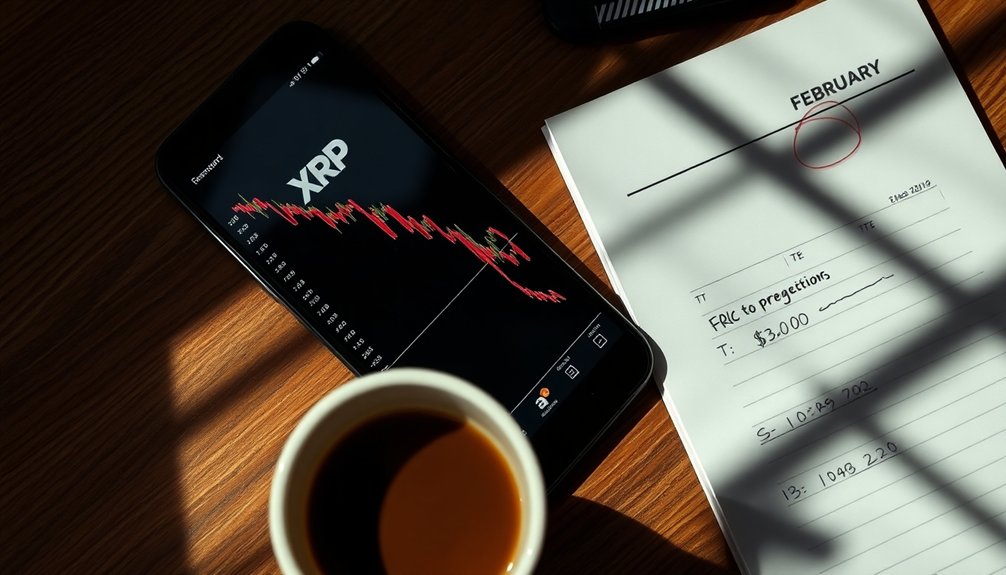

While crypto markets wobbled through February’s volatility, Ripple revealed a series of heavyweight partnerships and feature rollouts that could reshape the XRPL ecosystem for years to come. The standout announcement? Aviva Investors joining forces with Ripple on February 11, 2026, marking the first European investment management business to tokenize traditional fund structures on the XRP Ledger. Not just another press release. This is the real deal.
Ripple’s strategic Aviva partnership isn’t just noise—it’s institutional validation for XRPL’s tokenization future.
The February ledger update introduces permissioned DEXs scheduled for Q2 2026 and a native lending protocol rolling out in Q1. These aren’t minor tweaks—they’re addressing a massive gap in on-chain yield for XRP holders. About time, right?
Meanwhile, the Zand Bank partnership is already live, creating a bridge between AEDZ stablecoin and RLUSD on XRPL. Ripple has successfully removed key barriers for banks on the XRP Ledger, potentially unlocking billions in institutional flows. Investors looking to capitalize on this development should consider sector-based diversification to balance their exposure to various blockchain technologies.
XRP’s price hasn’t exactly matched the excitement. After hitting $2.40, it retraced to the $1.50 range. But aggressive buy-backs at the $1.43-$1.45 level suggest smart money sees value. Break above the 100-day EMA at $2.22, and we’re looking at $2.35-$2.80 territory.
Behind closed doors, Wall Street giants are paying attention. BlackRock, Mastercard, and Franklin Templeton are actively evaluating XRPL technology. They’re not doing this for fun. The pressure’s on banks to upgrade their prehistoric cross-border payment systems, and XRPL’s 4 billion processed transactions since 2012 speak volumes.
Performance metrics show recent payment volumes hitting 1.88 million, maintained by 120 independent validators. No mining required. Energy efficiency matters these days.
The White House forecasts mainstream tokenization in 1-3 years, perfectly timed with the Clarity Act reducing legal risk for XRP in 2026. The update introduces powerful Multi-Purpose Tokens designed specifically for real-world asset tokenization that financial institutions have been demanding. The network now supports 7 million active wallets—a number that will seem quaint in retrospect.
For investors obsessing over daily price movements, perhaps it’s time to zoom out. XRPL isn’t building for the next pump. They’re positioning for the decade when tokenization moves from buzzword to banking backbone. That’s the real update.