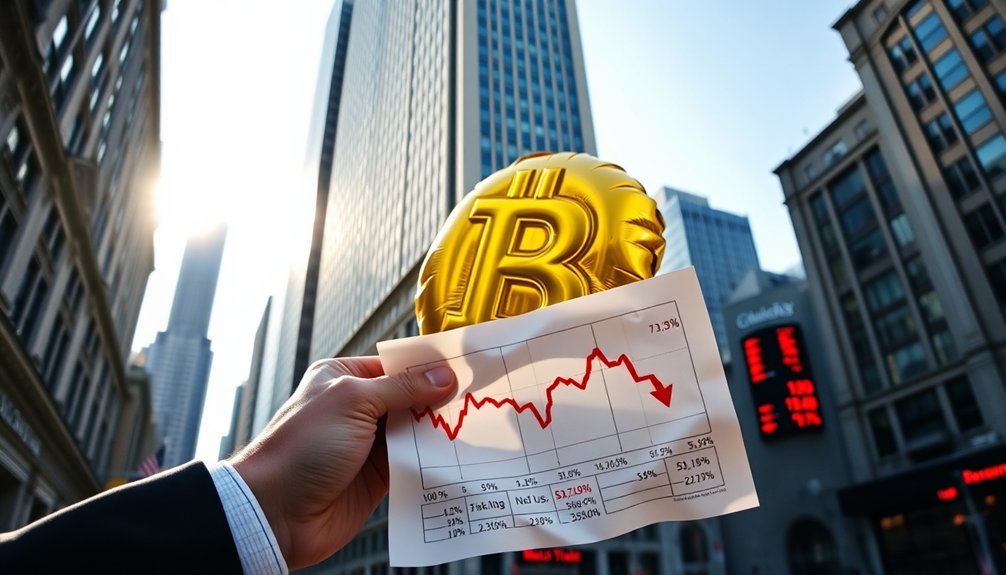

As Bitcoin’s correlation with the Nasdaq hit a staggering 0.68 over the past month, Wall Street‘s love affair with cryptocurrency has transformed the digital asset into something entirely different than early adopters imagined. The shift is dramatic. Bitcoin’s volatility now correlates at 0.88 with stock volatility—the highest level ever recorded. So much for being an independent asset class.
The numbers tell a brutal story. Bitcoin’s correlation to equities surged from a modest 0.15 in 2021 to a whopping 0.75 by January 2026. This five-year transformation wasn’t driven by fundamentals or adoption. Nope. It’s all about institutional risk management and mechanical trading. Wall Street shows up and suddenly Bitcoin moves like tech stocks on steroids.
This correlation disaster has killed Bitcoin’s diversification appeal. At 0.75, it’s too correlated to provide meaningful portfolio benefits. Instead of hedging against market downturns, Bitcoin now amplifies losses during crashes. Quite the opposite of what institutional investors initially signed up for. Retail investors are catching on too.
Bitcoin’s dance with the market has turned from diversification dream to volatility nightmare, leaving investors questioning its portfolio role altogether.
The disconnect between price and fundamentals is laughable. Daily active addresses declined while Bitcoin rallied to $96,000. Transaction volumes dropped even as “institutional adoption” supposedly accelerated. Meanwhile, Lightning Network payments grew 266% year-over-year while prices fell. Make it make sense.
Bitcoin’s suffering from a full-blown identity crisis. Is it digital currency? Technology stock? Inflation hedge? Strategic reserve? It’s trying to be everything and failing at most of it. The failure to perform as digital gold was evident when gold soared to $5,500 while Bitcoin crashed to $80,000 in 2026. As a tech stock substitute, it’s particularly disadvantaged—no revenue, no earnings, no quarterly reports to justify its valuation.
The market’s confusion was on full display when Bitcoin crashed 15% in a single day this January, eventually settling into a volatile range between $69,000 and $72,000. Short-term traders watch liquidity and order books, waiting for direction. The current trading range reflects ongoing investor uncertainty as both skeptics and enthusiasts monitor the market for their next move.
Wall Street’s embrace has fundamentally changed Bitcoin’s character. The relationship with traditional markets is inescapable now. Despite its massive market capitalization of approximately $2.28 trillion, Bitcoin continues to struggle with its identity in the financial ecosystem. And Bitcoin, caught between conflicting identities, continues to suffer the consequences.