
Cryptocurrency is particularly volatile due to various interconnected factors. Regulatory uncertainty creates market instability, while continuous 24/7 trading amplifies sharp price movements. Low liquidity in altcoins makes them especially sensitive to shifts. Additionally, macroeconomic influences, like interest rates and geopolitical events, heighten price fluctuations. Speculative trading further exacerbates this volatility, with market sentiment rapidly changing. Together, these elements contribute to the unpredictable nature of the crypto landscape, leading to significant price swings. More insights await.
Crypto volatility presents a unique challenge in the financial landscape, driven by various factors that create rapid price fluctuations. One of the most significant contributors to this volatility is regulatory uncertainty. The lack of clear, thorough government regulations fuels market instability, resulting in sudden price swings. For instance, regulatory enforcement actions, such as investigations by the SEC, can lead to sharp crashes. A notable example is the SEC’s case against Ripple, which caused a staggering $16 billion loss in market cap, equating to a 63% decline in the price of XRP.
In addition, announcements or changes in regulations can trigger bursts of volatility as traders react to potential shifts in the legal status or operational constraints of cryptocurrencies. The fragmented regulatory environment across different countries adds another layer of unpredictability to the market. Implementing strong internal controls can help mitigate some of these risks and enhance overall market stability. Furthermore, the dominance of Bitcoin in market capitalization often influences how altcoins react to regulatory news.
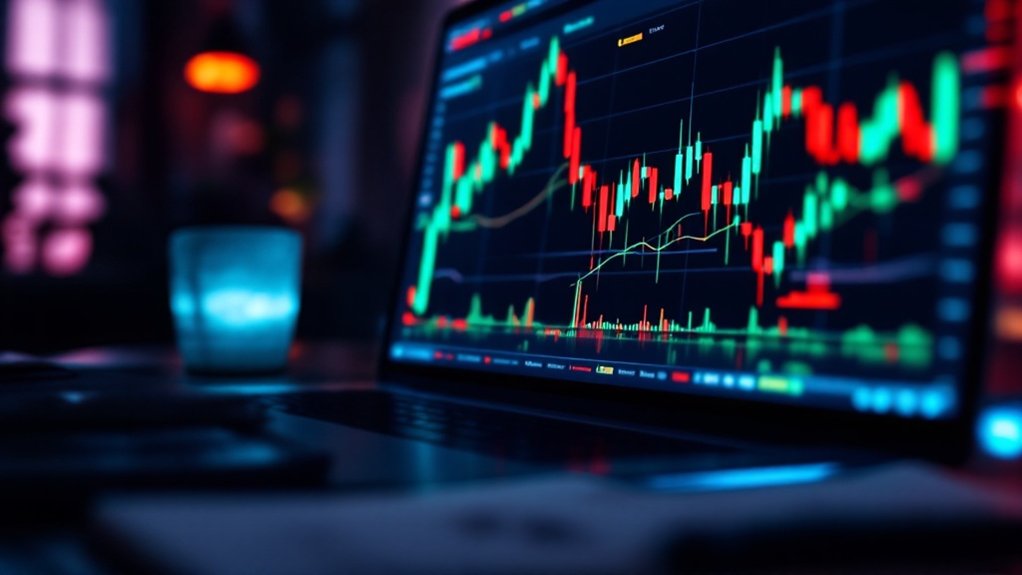
Additionally, the continuous trading dynamics of crypto markets exacerbate price volatility. Unlike traditional exchanges that have defined trading hours, cryptocurrency markets operate 24/7, exposing them to extreme price movements without the safety nets of trading halts or circuit breakers. This nonstop trading environment amplifies rapid price changes, as news and sentiment can spread instantaneously, leading to panic selling or market shocks. Consequently, participants face heightened risks of flash crashes or runs at any point in the global trading day.
The 24/7 nature of crypto markets fuels extreme price volatility, heightening risks of sudden market shocks and flash crashes.
Market liquidity and derivatives exposure further complicate volatility. Certain altcoins and smaller cryptocurrencies often suffer from low liquidity, making them particularly sensitive to price movements resulting from trades. With the derivatives market exposure reaching approximately $220 billion, forced liquidations can lead to cascading price swings. Bitcoin’s dominance can provide a level of stability amidst broader market speculation, but it does not eliminate the overall volatility in the market. Amberdata’s role in illuminating intricate market movements through detailed analytics is crucial for understanding these dynamics.
Liquidity gaps during sharp selloffs exacerbate volatility, particularly for less mature tokens. Large derivative positions can increase risks linked to margin calls and abrupt deleveraging events, while institutional involvement, although it can concentrate liquidity, introduces complex layers of leverage that can amplify market reactions.
Macroeconomic and geopolitical factors also play an essential role in crypto volatility. Interest rate policies, inflation levels, and geopolitical tensions—such as trade wars—can directly affect crypto demand and price stability. For example, a $160 billion market crash often correlates with risk-off episodes prompted by global uncertainties.
Despite crypto’s tendency to show a negative correlation with traditional markets, macroeconomic uncertainties drive heightened volatility as investor risk aversion and speculative trading intensify. Ultimately, these intertwined factors create a landscape where volatility remains a defining characteristic of the cryptocurrency market.
Frequently Asked Questions
What Is the History of Cryptocurrency Price Fluctuations?
The history of cryptocurrency price fluctuations is marked by extreme volatility since Bitcoin’s inception in 2009.
Initial price surges and crashes characterized early years, with Bitcoin experiencing considerable rallies and dramatic declines.
The emergence of altcoins and speculative trading intensified price swings from 2014 to 2017.
Institutional interest and regulatory scrutiny further influenced volatility between 2018 and 2023.
Recent developments, including ETF approvals and market stabilization efforts, have also impacted price movements considerably.
How Does Regulation Impact Cryptocurrency Stability?
Regulation considerably impacts cryptocurrency stability by providing a framework that fosters market confidence and reduces uncertainty.
Clear regulatory guidelines help mitigate volatility by establishing rules for investors and issuers, while emerging regulations, like the EU’s MiCA, aim to harmonize standards.
Conversely, unclear regulations can lead to market swings, and poorly regulated stablecoins pose systemic risks.
Can Crypto Volatility Be Predicted?
Yes, crypto volatility can be predicted, though with inherent challenges. Various probabilistic forecasting approaches, including multi-model stacking frameworks and machine learning techniques, enhance prediction accuracy.
Statistical models like GARCH capture volatility characteristics, while innovations in machine learning enable intraday forecasting.
Despite high noise levels and market immaturity, combining diverse models can yield valuable insights.
Ultimately, predicting crypto volatility requires an understanding of complex dynamics and the use of ensemble forecasting for robustness.
What Role Do Whales Play in Crypto Markets?
Whales play a pivotal role in crypto markets by controlling significant quantities of assets, enabling them to impact prices through large buy or sell orders.
Their movements can create sharp price fluctuations, influencing market sentiment and liquidity.
By executing strategic trades, whales can manipulate market trends, often triggering reactions from smaller investors.
Monitoring whale activity helps traders anticipate price movements and adjust strategies, highlighting the profound effect these entities have on overall market dynamics.
How Can Investors Protect Themselves From Volatility?
Investors can protect themselves from volatility by employing diversification strategies, such as spreading investments across various cryptocurrencies and traditional assets.
Utilizing risk management techniques like stop-loss orders and dollar-cost averaging helps mitigate losses. Staying informed about macroeconomic indicators and regulatory developments enables better decision-making.
Additionally, maintaining emotional discipline and a long-term perspective reduces impulsive reactions to market fluctuations, ultimately fostering a more resilient investment approach in the face of volatility.