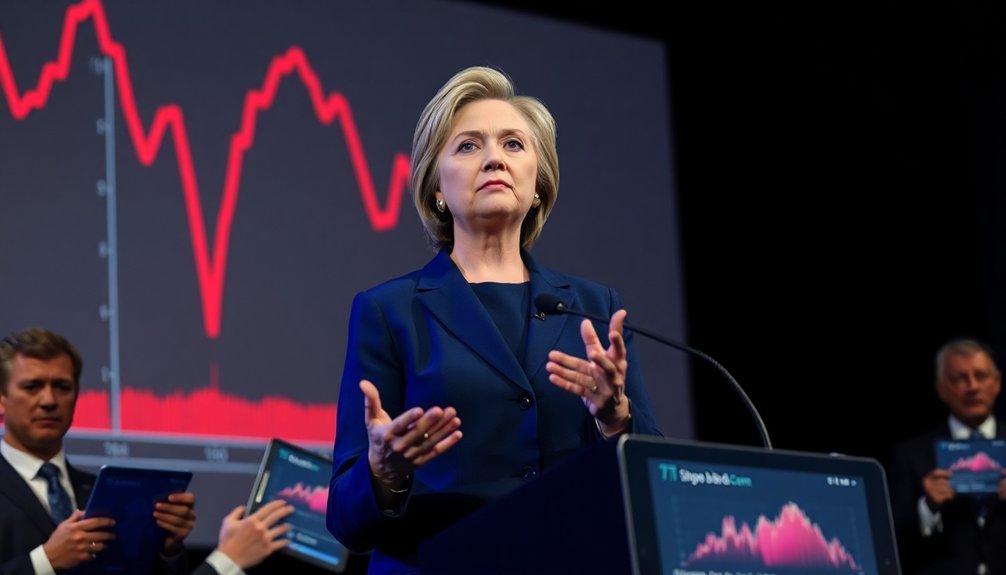

While Bitcoin hit new highs in 2025, former Secretary of State Hillary Clinton’s 2021 warnings about cryptocurrency risks now seem eerily prescient.
During a video appearance at the Bloomberg New Economy Forum, Clinton urged nations to pay “greater attention” to the rise of digital currencies. She wasn’t mincing words when she compared crypto to threats like artificial intelligence. Nobody listened.
Fast forward to late 2025. Bitcoin crashed below $80,000, wiping out all gains made earlier in the year. The cryptocurrency that once soared to $126,198.07 came crashing down in spectacular fashion.
A 57% increase from 2021 to its all-time high? Gone in a flash.
El Salvador, the first country to embrace Bitcoin as legal tender, is feeling the pain. Their unrealized gains plummeted from $245 million to around $80 million in just one month. That’s a staggering 65% decline. Yet they keep buying more. Talk about doubling down on a bad bet.
Bhutan fared slightly better but still took a hit. Their crypto profits fell from $984 million to $832 million—a 15% drop. Not as devastating as El Salvador’s losses, but still nothing to sneeze at.
Clinton specifically warned that these “exotic” cryptocurrencies could undermine traditional currencies and threaten the dollar‘s position as the global reserve currency. She predicted smaller nations would feel the impact first. Right on the money.
The crypto market, largely unregulated and volatile, proved vulnerable to exactly the kind of manipulation Clinton cautioned against. No oversight, no safety net. Just free-falling values and devastated national reserves.
Four years after Clinton’s warning, nations that gambled on Bitcoin are watching their balance sheets deteriorate. Turns out, building national reserves on digital assets might not be the financial revolution some promised. Even the U.S. government experienced a 33% drop in profits from $24 billion to $16 billion.
Clinton called it in 2021. Maybe next time, world leaders will pay attention to warnings before betting their countries’ futures on digital coins. When Clinton specifically mentioned Bitcoin as a risk, she highlighted a cryptocurrency that would eventually devastate national reserves.
Investors might have avoided these catastrophic losses by implementing tiered stop-loss orders to protect their positions during the market’s dramatic decline.