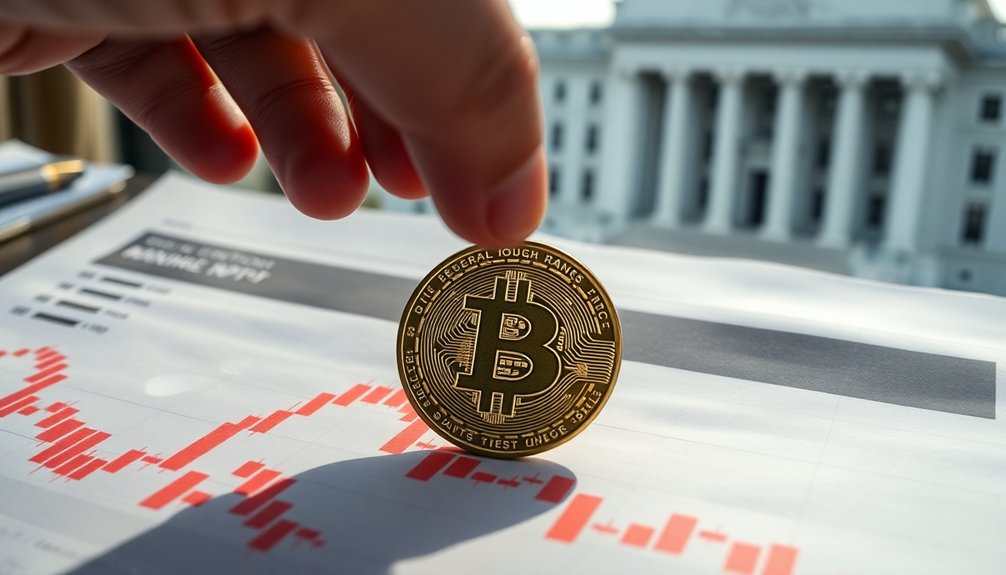

As Bitcoin hovers at $95,137 USD, the digital asset continues its positioning as a hedge against traditional currency instability. Despite falling 5.87% over the last 12 months, Bitcoin gained nearly 8% in the past four weeks. Not too shabby for a “digital pet rock,” as critics once called it.
Bitcoin’s resilience at $95K reinforces its evolution from mocked “pet rock” to legitimate hedge against financial uncertainty.
The European Central Bank’s warnings about political tensions threatening dollar stability have investors scrambling for alternatives. And where do they turn? Bitcoin, of course. With U.S. fiscal deficits expanding faster than a politician’s promises, the case for non-dollar denominated holdings grows stronger by the day. Many budget-conscious investors implement a core-satellite approach to maintain exposure while managing risk effectively.
The fallout from America’s Venezuela attack isn’t helping dollar sentiment either. Speculation runs wild about sanctioned governments potentially holding Bitcoin. Well, wouldn’t you if your access to global markets was cut off? The logic isn’t exactly rocket science.
Bitcoin’s total market value approaches $2 trillion. That’s trillion with a “T.” It now functions primarily as a decentralized store of value and reserve asset. Long-term investors view recent dips as buying opportunities. Smart move or financial suicide? Time will tell.
Major financial institutions have jumped on the Bitcoin bandwagon. Standard Chartered projects $150,000 by year-end. JPMorgan Chase estimates $170,000. Bernstein even forecasts $200,000 by 2027. Recent market trends show Bitcoin hit a 7-week high near $95,000 in early January, bolstering institutional confidence. The current Fear & Greed Index score of 29 indicates extreme market fear, potentially signaling a buying opportunity for contrarian investors. Remember when these same banks called Bitcoin a fraud? Funny how money changes minds.
Bitcoin ETF inflows remain robust, providing vital price support. The regulatory landscape, while still murky, increasingly treats Bitcoin as a commodity rather than currency. Progress, albeit slow.
Not all forecasts are rosy. Morgan Stanley warns the four-year cyclical pattern persists, suggesting the bull market may be nearing its end. Bitcoin’s experienced a 30% decline since October 2025, with the quarter tracking toward a 22% loss.
Bitcoin’s extreme volatility—often swinging 5-10% weekly—isn’t for the faint-hearted. But as central banks globally lean toward rate cuts and money supply increases, Bitcoin’s appeal as currency debasement protection grows. It’s a wild ride, but increasingly looks like the only game in town.