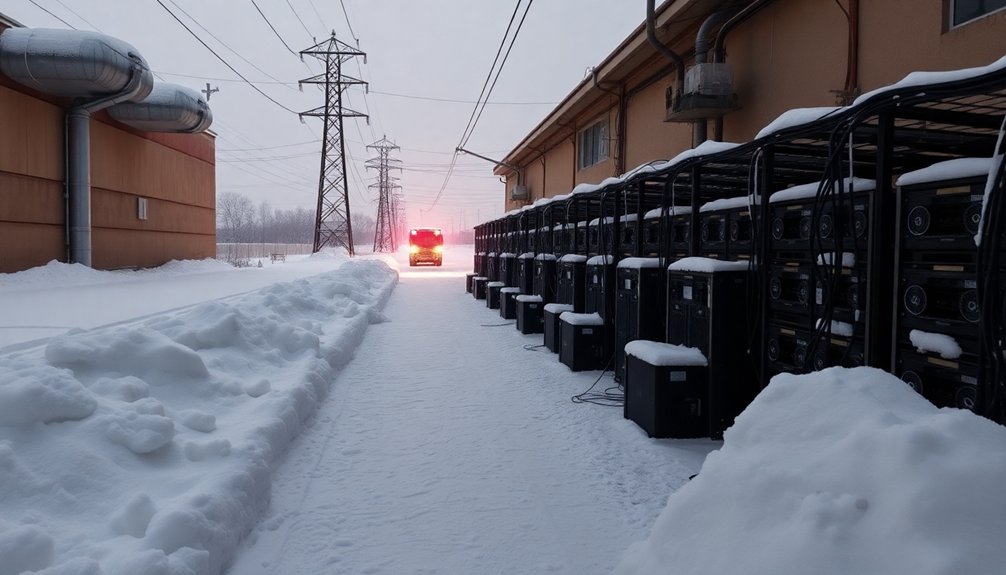

As winter storm “Fern” blasted across more than three dozen US states with life-threatening conditions, Bitcoin’s network took a massive hit. The cryptocurrency’s hashrate plummeted by a staggering 40% in just two days, dropping to 663 exahashes per second—the lowest level in seven months.
Yeah, that’s what happens when a massive winter storm wreaks havoc across 3,000 kilometers, from Texas to New England.
Bitcoin mining operations across the US didn’t just slow down—they practically hit the brakes. Marathon Digital saw daily Bitcoin production nosedive from 45 BTC to a measly 7 BTC. IREN wasn’t spared either, with output shrinking from 18 to 6 BTC.
When freezing temperatures left a million customers without power, miners had to make a choice. They chose to help.
These mining operations didn’t shut down because they wanted to. They did it because the grid needed relief. Fast. US miners represent about 38% of Bitcoin’s global hashrate. When they power down, the network feels it. Big time.
US miners didn’t power down by choice. They stepped up when the grid screamed for help, proving their value beyond the blockchain.
Here’s the interesting part: many miners actually have formal agreements with utility companies. CleanSpark, Riot Platforms, and Bitdeer operate under demand-response programs. The Tennessee Valley Authority even incentivizes large power users to reduce consumption during peak stress periods.
It’s not charity—it’s business.
Mining farms demonstrated their value as “flexible load” for power systems. With over 130 dedicated mining sites across the US, they collectively wield significant power to support grid stability during extreme weather events.
When households and critical infrastructure needed electricity most, miners scaled back operations within hours. They absorbed excess electricity during off-peak times and freed up capacity when demand surged. Peer-reviewed research has confirmed that Bitcoin mining strengthens electrical grids rather than destabilizing them.
By Monday, as weather improved, the hashrate rebounded to 854 EH/s. Crisis averted. Network resilient.
The whole episode proved something mining advocates have claimed all along: these operations can strengthen grid stability, not just drain it. They scale consumption up or down to match conditions.
Miners aren’t just digital gold diggers—they’re becoming integrated with US energy markets. The decentralized ledger technology that powers Bitcoin enables resilient network operations even when significant portions of mining capacity go offline. Not bad for a bunch of computers solving math problems.