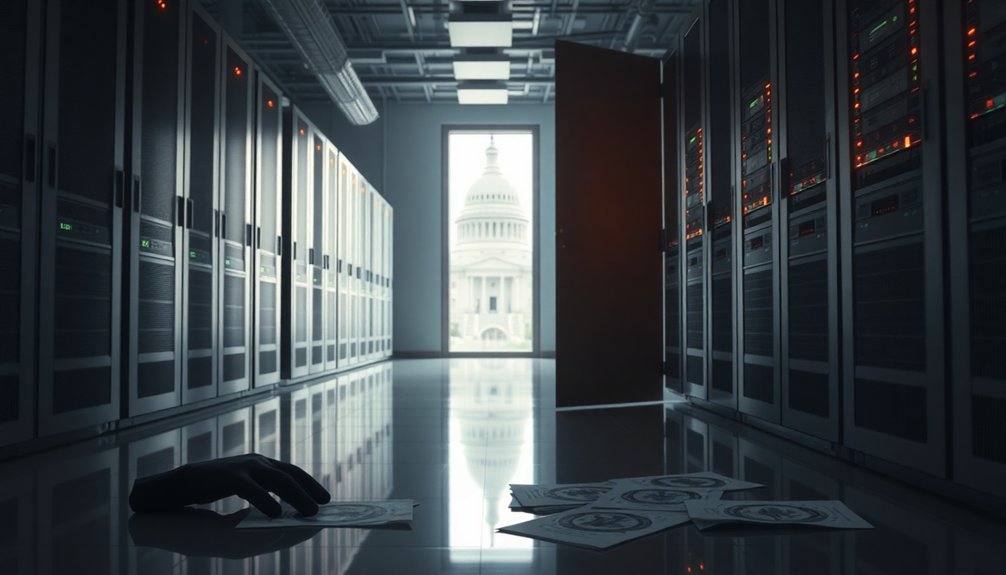

While government officials have repeatedly assured the public their Bitcoin holdings were secure, a shocking weekend heist suggests otherwise. Cryptocurrency investigator ZachXBT dropped a bombshell report claiming over $40 million had been siphoned from US government seizure wallets. The total linked to the suspect? A staggering $90 million. Not exactly pocket change.
The alleged culprit goes by “Lick” or “John,” reportedly identified as John Daghita. Here’s where it gets interesting. Daghita has family connections to Command Services & Support (CMDSS), a contractor managing seized crypto for the US Marshals Service. Talk about an inside job.
The thief’s family ties to the very contractor safeguarding government crypto redefines nepotism in the digital age.
The theft came to light in the most 2025 way possible – during a Telegram “band-for-band” wealth dispute where the suspect shared his screen in real-time. Amateur hour, much? This accidental self-doxxing revealed wallet control that shouldn’t have been possible.
Nearly $25 million was traced from a government-controlled wallet connected to the infamous 2016 Bitfinex hack just this March. Then another $20 million vanished in October. The government’s cryptocurrency custody system is clearly a mess – fragmented across multiple agencies and contractors with questionable security protocols. A 2022 Department of Justice audit had previously warned about serious custody gaps that could lead to asset losses. Proper segregation of duties could have prevented this security breach by ensuring no single individual had complete control over these valuable assets.
Uncle Sam is sitting on somewhere between 198,000 and 300,000 Bitcoin worth around $28 billion. That’s a serious national asset. President Biden’s March Executive Order established a formal Strategic Bitcoin Reserve, fundamentally a “digital Fort Knox.” Except Fort Knox doesn’t typically leak billions.
This isn’t the first suspicious activity. In October, $20 million disappeared from a government wallet, though most was mysteriously returned within 24 hours. The tracked funds revealed sophisticated laundering patterns involving splitting, cycling, and reconsolidation through multiple exchanges to hide their origins. Officials denied selling the assets, but transparency remains elusive.
The implications are enormous. If the government can’t properly secure its Bitcoin holdings, how can it function as a reliable reserve asset? Investor confidence is shaken, and calls for a thorough audit grow louder by the day.
One thing’s clear: America’s Bitcoin treasure needs better guards.