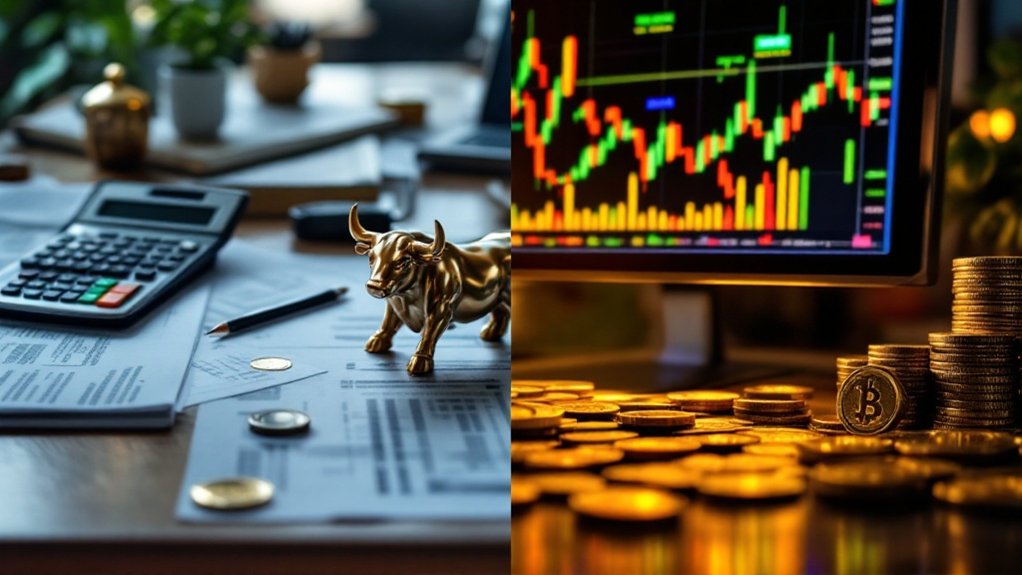

Cryptocurrencies and traditional investments vary greatly in several key areas. Trading behavior differs, with crypto investors often employing momentum strategies, while traditional investors tend to take a contrarian approach. Market structures are starkly different, as cryptos operate in a decentralized, lightly regulated space, unlike heavily regulated stock markets. Volatility is much higher in cryptocurrencies, attracting speculative traders. Additionally, supply dynamics vary, impacting liquidity. Understanding these differences is essential for investors looking to navigate both markets effectively.
As the financial landscape evolves, investors increasingly find themselves weighing the merits of cryptocurrencies against traditional investments. One notable difference lies in trading behavior and investor strategies. Cryptocurrency investors often adopt a momentum strategy, increasing their holdings in assets that have recently appreciated and maintaining them through downturns. In contrast, traditional investors typically employ a contrarian approach, reducing their stakes after price increases and purchasing during declines, particularly surrounding earnings announcements. This divergence is partly attributed to the lack of formal valuation models and financial disclosures in the cryptocurrency market, which encourages momentum trading. Additionally, trading behaviors remain distinct regardless of investor demographics, indicating that the nature of the asset significantly influences trading strategies.
Market structure and regulation also present stark contrasts between these two investment types. Traditional stock markets are heavily regulated by government agencies and organized exchanges, which enforce listing rules and offer protections for investors. Conversely, cryptocurrencies function in a largely decentralized environment devoid of regulatory oversight and centralized control. Transactions in the crypto space are recorded on blockchain technology, ensuring transparency and traceability, yet limiting the scope for regulatory intervention. Cryptocurrencies lack the same level of regulatory oversight as traditional investments, which adds to their risk profile. Furthermore, Bitcoin’s dominance in market capitalization contributes to its perceived stability compared to more volatile altcoins.
The stark differences in market structure highlight the regulatory rigor of traditional investments versus the decentralized nature of cryptocurrencies.
Unlike traditional investments that necessitate intermediaries such as brokers and clearinghouses, crypto transactions can occur directly between parties, though this peer-to-peer structure increases the risk of fraud and market manipulation.
The volatility and risk profiles associated with cryptocurrencies further distinguish them from traditional assets. Cryptocurrencies are notorious for their extreme price volatility, with values fluctuating dramatically within mere minutes or days. On the other hand, traditional investments like stocks and bonds usually exhibit lower volatility and more predictable price movements, thanks to established histories and regulatory transparency. The allure of this volatility often attracts speculative traders, as it presents opportunities for substantial returns, albeit with increased risk. Curiously, incorporating bitcoin into diversified portfolios may enhance risk-return profiles, despite its volatility raising conditional Value at Risk (CVaR).
Finally, the supply and market size of cryptocurrencies diverge notably from those of traditional investments. Some cryptocurrencies, like Bitcoin, are designed with fixed supply caps to create a sense of scarcity, while others may have unlimited issuance. Stocks represent ownership in companies, with their supply controlled by corporate operations and governance. The global stock market is vastly larger, valued at approximately $106 trillion compared to around $2.6 trillion for cryptocurrencies as of 2021. This limited market size of cryptocurrencies leads to lower liquidity and greater susceptibility to price swings from substantial trades, further highlighting the stark differences between these two investment avenues.
Frequently Asked Questions
What Are the Tax Implications of Investing in Crypto?
Investing in crypto carries specific tax implications, including capital gains tax upon sale or disposal, taxed at short-term or long-term rates based on holding periods.
Ordinary income tax applies to crypto earned through various means, like mining and payments.
Effective 2025, brokers will report transactions, enhancing compliance.
The complexity of crypto transactions, such as trading and purchases, further complicates tax obligations, necessitating careful record-keeping for accurate reporting and compliance.
How Do Crypto Wallets Work for Beginners?
Crypto wallets function by generating a cryptographic key pair, allowing users to send and receive cryptocurrencies securely.
Beginners select wallet types based on ease of use and security. Hosted wallets offer simplicity, while non-custodial wallets provide more control.
Users must manage their private keys carefully, as these are essential for signing transactions.
Wallets also facilitate interactions with decentralized apps, enabling users to engage in various blockchain activities while maintaining digital security.
Can I Convert Crypto to Cash Easily?
Yes, converting crypto to cash can be relatively easy through various methods.
Centralized exchanges like Coinbase and Binance facilitate quick conversions, while peer-to-peer platforms offer negotiation options with potentially lower fees.
Crypto ATMs provide immediate cash access but may impose higher fees.
Users must consider factors such as transaction speed, costs, and verification requirements, ensuring they choose the method that aligns with their needs for convenience and security.
What Security Measures Should I Take for Crypto Investments?
To secure crypto investments, individuals should employ strong encryption for private keys, utilize hardware wallets for offline storage, and implement multi-factor authentication.
Regular software updates and secure backups of wallet data and recovery phrases are essential.
Additionally, choosing exchanges with robust security measures, such as cold storage and two-factor authentication, further mitigates risk.
Vigilance against phishing attacks and maintaining transparent records for regulatory compliance are also critical components of an all-encompassing security strategy.
How Do I Choose a Crypto Exchange?
To choose a crypto exchange, one should consider several key factors.
First, evaluate the exchange’s security measures, such as cold storage and multi-factor authentication.
Next, assess its regulatory compliance, guaranteeing it follows anti-money laundering and user protection guidelines.
Additionally, examine the exchange’s reputation, including its history of security breaches and user reviews.
Finally, consider the user interface and support services to verify a seamless trading experience.