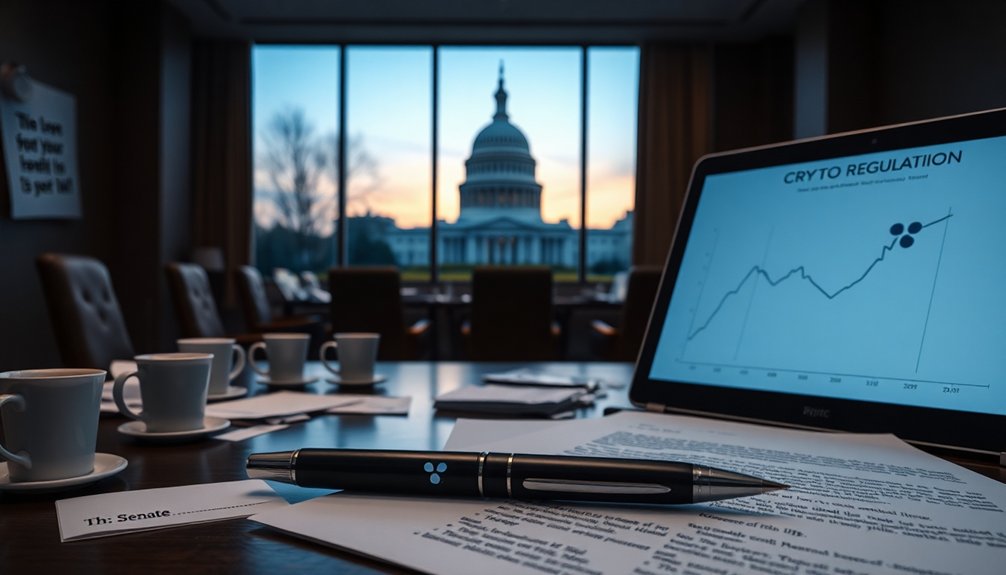

Crypto giants are doubling down on a high-stakes political gamble. The CLARITY Act, framed as thorough crypto market structure legislation, has become the industry’s latest obsession. Companies like Ripple are betting big that this Senate deal will finally draw clear lines between digital commodities and securities—the regulatory distinction that’s been haunting them for years.
Crypto’s elite pushing all their chips toward CLARITY Act—their Hail Mary for regulatory salvation.
It’s not complicated why they care so much. Ripple’s XRP has been stuck in SEC litigation purgatory, and this bill could be their get-out-of-jail-free card. The legislation, jointly overseen by the Senate Agriculture and Banking Committees, promises to define when digital assets qualify as commodities versus securities. No more guessing games. No more arbitrary enforcement.
For XRP holders, this matters. A lot. The “security” label has kept major U.S. exchanges from listing XRP and scared away institutional money. Market analysts have even flagged XRP as potentially the biggest winner if the CLARITY Act passes. Same goes for Ethereum and Cardano. These coins have underperformed during regulatory uncertainty. Not exactly shocking.
The timing, though? That’s where things get messy. Senate committees were set to mark up their portions on January 15th. But now there’s talk the whole process could drag into 2027. Yes, you read that right. 2027. Investment bank TD Cowen has specifically warned about growing political risk as the 2026 midterm elections approach.
It’s a classic Washington story. Big promises, endless delays. The Trump administration’s accommodating stance toward crypto has raised industry hopes, but that alone may not be enough to overcome legislative hurdles. Investors without clear investment goals often struggle most during these extended periods of regulatory uncertainty.
Industry players pitched this as “make-or-break” legislation—the key to releasing institutional participation and keeping crypto innovation in America instead of pushing it overseas. They’re tired of the SEC’s case-by-case enforcement approach. They want rules of the road.
For Ripple specifically, this is existential. A favorable outcome means protection against reclassification and retroactive enforcement. It means U.S. institutions could finally touch XRP again. Without it? More years in regulatory limbo.
The crypto industry’s big bet on Congress is looking shakier by the day.