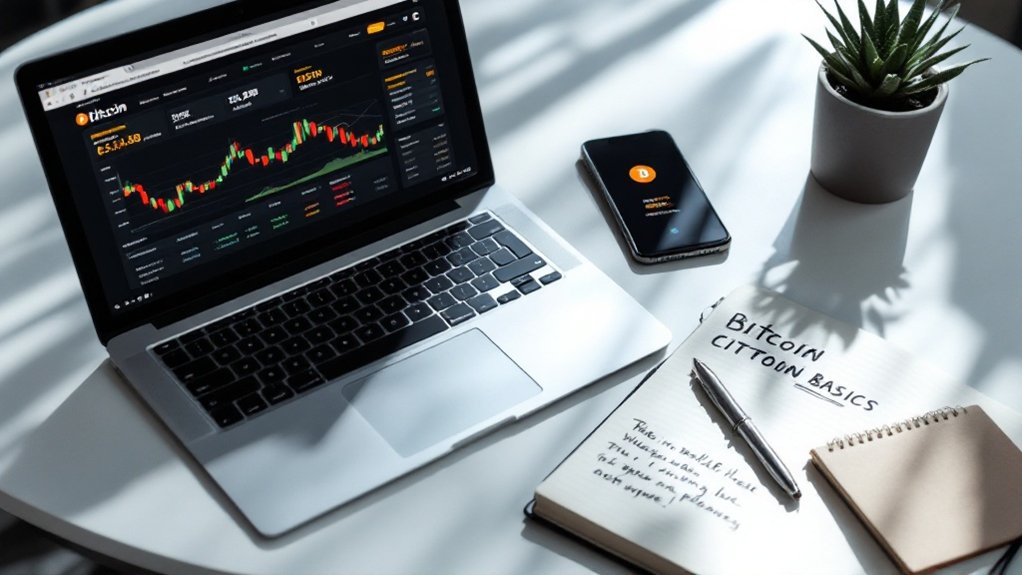

To buy Bitcoin, one should first select a reputable exchange that supports Bitcoin transactions. After creating and verifying an account by providing personal details and completing the KYC process, the next step involves funding the account using methods like bank transfers or credit cards. Once funded, users can choose their desired amount of Bitcoin to purchase. It’s essential to secure the investment by transferring Bitcoin to a personal wallet for protection. More insights await those looking to enhance their cryptocurrency journey.
As individuals explore the world of cryptocurrency, understanding how to buy Bitcoin becomes fundamental. The first step in this journey is selecting a reliable cryptocurrency platform. It is essential to choose a reputable exchange, such as Coinbase, Gemini, or CEX.IO, which have garnered positive user reviews and robust security features. Users must guarantee that the platform supports Bitcoin purchases and offers options for withdrawals. Additionally, the availability and legality of the platform based on the user’s country or state should be confirmed, especially in regions like the United States where Bitcoin is legal to buy, trade, and hold. A user-friendly interface is also important for beginners, along with transparency in fee structures, including trading and withdrawal fees. Coinbase’s interface is designed to be especially intuitive for new users.
Once a platform is selected, the next step involves creating and verifying an account. Users must register by providing personal information and identity verification documents as part of the Know Your Customer (KYC) process. This verification is necessary for accessing full trading and withdrawal functionalities.
To bolster account security, enabling two-factor authentication (2FA) is recommended, as is verifying the email and phone number associated with the account. Users should also be aware of account limits, as some platforms impose restrictions on deposits or trading until full verification is complete. Additionally, users should consider using a cold wallet for enhanced security when storing their Bitcoin.
The next phase is funding the account, which can be done through various payment methods such as bank transfers, debit or credit cards, e-wallets, or PayPal, depending on the options available on the chosen platform. Bank transfers typically incur the lowest fees but may take several days to process, while credit or debit card transactions provide instant funding at the cost of higher fees. It is important to note that most exchanges are not FDIC insured, which adds an additional layer of risk to the funding process.
It is advisable to compare the fees associated with deposits across platforms prior to funding an account.
After funding, users can proceed to choose the amount of Bitcoin to buy. Many beginners opt for Bitcoin due to its liquidity and relative stability compared to altcoins. Reviewing the coin’s fundamentals and market cap can aid in making informed decisions.
Users should determine their investment amount based on their budget and risk tolerance, and it is wise to refrain from purchasing unfamiliar or highly volatile altcoins until gaining more experience.
Finally, users navigate to the “Buy/Sell” section to specify the amount of Bitcoin they want to purchase. It is important to review transaction fees before confirming the purchase.
Once the transaction is complete, securing the investment is crucial. Transferring Bitcoin from the exchange to a secure wallet, whether hot or cold, will minimize risk. Creating and securely storing recovery phrases offline is essential for maintaining asset security.
Frequently Asked Questions
What Is the Minimum Amount of Bitcoin I Can Buy?
The minimum amount of Bitcoin one can purchase varies considerably across exchanges.
For instance, Kraken allows purchases starting at $10, while bitFlyer has a minimum order of 0.00001 BTC, roughly equivalent to $1.10 at a price of $110,000 per Bitcoin.
Additionally, some platforms support buying in fractions of a Bitcoin, known as satoshis, enabling even small investments.
Ultimately, the exact minimum depends on the chosen exchange’s policies and fee structures.
Are There Any Hidden Fees When Buying Bitcoin?
Yes, there are hidden fees when buying Bitcoin. These can include spread fees, which occur when the purchase price exceeds market value, and premium fees for instant buy options.
Additionally, multiple conversion fees may arise if fiat currency is converted to stablecoins before purchasing Bitcoin. Maker and taker fees, along with various payment method-related fees, further complicate transactions.
Beginners should be cautious, as price transparency is often lacking on many platforms.
Can I Buy Bitcoin Anonymously?
Yes, Bitcoin can be purchased anonymously through various methods.
Peer-to-peer marketplaces, Bitcoin ATMs, and no-KYC platforms facilitate anonymous transactions without mandatory identification. Users can utilize cash, gift cards, or prepaid vouchers to enhance privacy.
While these methods often come with higher fees and potential risks, they offer a viable route for those prioritizing anonymity.
Employing privacy-enhancing tools like VPNs and secure wallets further strengthens user anonymity during the purchasing process.
How Long Does It Take to Receive My Bitcoin?
Receiving Bitcoin typically takes between 10 to 60 minutes, depending on network activity and transaction fees.
Each transaction requires confirmation through the addition of a block to the blockchain, which occurs approximately every 10 minutes.
However, high-value transactions may necessitate multiple confirmations, extending the wait time to over an hour.
Network congestion and fee levels greatly influence processing times, with miners prioritizing transactions that offer higher fees for quicker confirmations.
What Should I Do if I Lose Access to My Bitcoin Wallet?
If access to a Bitcoin wallet is lost, the individual should first identify the wallet type and locate any recovery information such as backup phrases or private keys.
They can then follow specific restoration procedures based on the wallet type.
For enhanced security, it’s essential to change passwords and enable two-factor authentication on related accounts.
Finally, transferring funds to a new wallet post-recovery can help safeguard assets against potential theft.