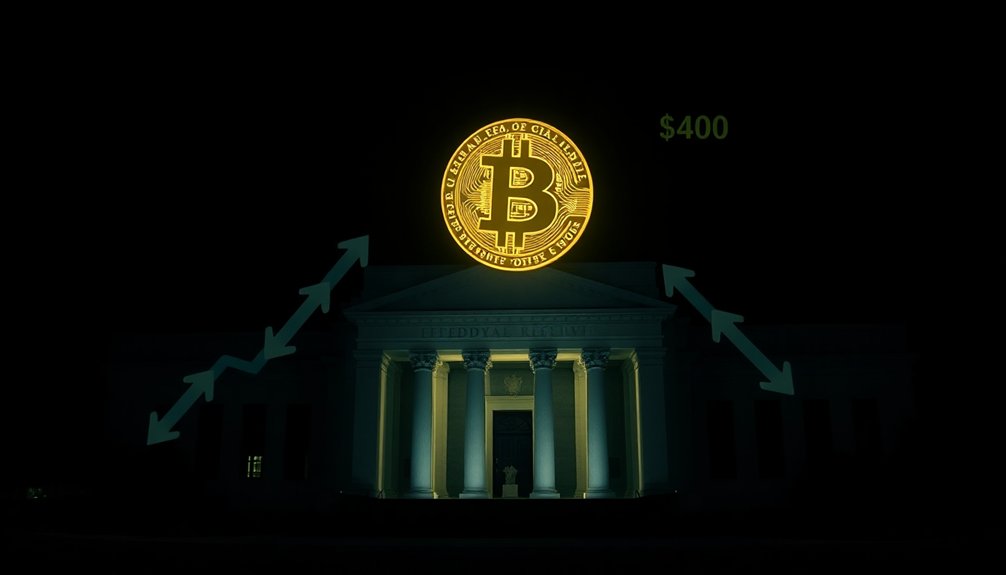

While market analysts debate countless factors affecting Bitcoin‘s price, the cryptocurrency’s relationship with Federal Reserve liquidity is impossible to ignore. Bitcoin tracks Fed monetary moves with remarkable consistency, showing an 84-day lag between money supply changes and price action. This isn’t rocket science—it’s just money chasing returns.
The numbers tell a clear story. When the Fed pumped the money supply by over 25% during 2020-2021, Bitcoin soared. No coincidence there. By late 2025, U.S. M2 hit $22.2 trillion with a 4.5% yearly increase. Global central banks pushed combined money supply past $105 trillion. That’s a lot of cash looking for a home.
Fed repo operations reveal another piece of the puzzle. A $13.5 billion overnight injection doesn’t directly push Bitcoin higher, but it sure creates the right conditions. Bitcoin acts like a high-beta asset—when dollar funding gets easier, Bitcoin tends to climb. When liquidity tightens, it struggles. Simple as that.
When money flows, Bitcoin grows. When taps tighten, crypto falters. The liquidity dance never stops.
The Fed’s quantitative tightening in 2025 squeezed crypto markets hard. Higher rates made boring old bonds look attractive again. Bitcoin’s correlation with the S&P 500 jumped to 0.72, proving it’s no longer the maverick it once was. It’s part of the financial system now, for better or worse. Small shifts in overnight repo markets often precede significant Bitcoin price movements, reflecting the cryptocurrency’s integration with traditional financial liquidity cycles. Investors with clear investment goals can better navigate this volatility by establishing acceptable loss thresholds and appropriate exit strategies.
September 2025’s quarter-point rate cut barely moved the needle. Markets had already priced it in. Yawn.
The real game-changer came on December 1, 2025, when the Fed officially ended quantitative tightening. This halt to the liquidity drain matters more than token rate cuts. Now $15-20 billion monthly from mortgage security paydowns gets redirected into Treasuries. The cryptocurrency also shows strong historical precedent with a correlation coefficient of up to 0.78 with M2 money supply during periods of aggressive monetary policy.
Rate cuts get headlines, but the $400 billion liquidity shift from ending QT is what smart money watches. Bitcoin responds to this liquidity pulse because, at the end of the day, it’s all about the money. Always has been.