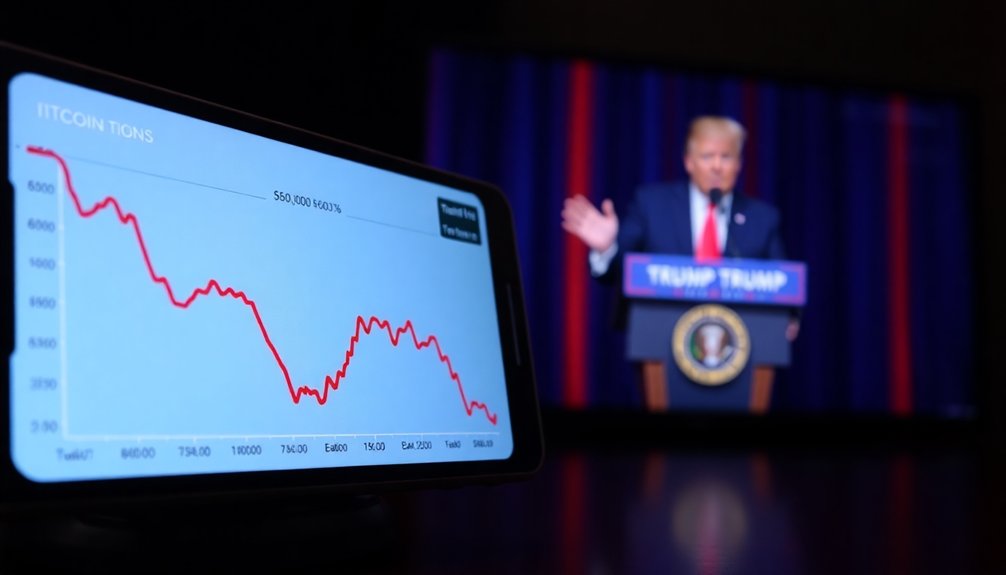

The once-reliable relationships between Bitcoin and traditional markets are shattering. Bitcoin’s 52-week rolling correlation with the Nasdaq Composite has plunged to its most negative level since March 2020. Meanwhile, it’s tracking the Japanese yen with a shocking 0.86 correlation over the past ninety days. So much for digital gold.
This isn’t just statistical noise. It’s a fundamental shift. The yen correlation explains 73% of Bitcoin’s recent price moves. That’s right—Bitcoin now behaves like a derivative tied to Japanese monetary risk. Not exactly the uncorrelated hedge everyone pitched it as.
Bitcoin has completely decoupled from gold and silver, which surged on macro forces while BTC tumbled. Down 30% from October highs, Bitcoin now hovers in the low $90Ks, occasionally slipping below. The $87,000 level looms as year-end approaches.
Bitcoin’s divorce from precious metals is complete. It’s fallen 30% from October peaks, flirting with sub-$90K territory as year-end bears down.
What’s happening? Markets are pricing in something terrifying. Something that breaks classic correlations and sends investors scrambling. Portfolio managers now include yen flows alongside U.S. real rates in their Bitcoin models. Not a great sign for the “clean hedge” narrative.
The risks are piling up. Dollar credibility issues. Term premium concerns. Central bank tightening. That Venezuelan Bitcoin stash potentially hitting markets. Unlike altcoins with their higher volatility risk, Bitcoin’s limited supply of 21 million coins was supposed to provide stability in these uncertain times. These rapid shifts mirror previous market cycles where boom-bust-consolidation patterns have defined Bitcoin’s long-term trajectory. Approximately $10.65 billion in leveraged long positions could face liquidation if prices drop below $84,000, creating a cascading sell-off. Any negative shock could cascade to $80,000 through margined long liquidations. Ouch.
Some experts are running for the exits. Luke Gromen sold most of his Bitcoin around $95K. He’s expecting more pain into Q1 2026. Mining pressures from energy costs aren’t helping either.
Bulls counter that institutional inflows could drive prices to $150,000, even $170,000 in a Fed crisis scenario. They point to ascending triangle patterns and growing demand. Maybe they’re right.
But this correlation breakdown changes everything. What good is a hedge that doesn’t hedge? Bitcoin’s new sensitivity to liquidity and risk appetite makes it vulnerable to systemic shocks. The perfect storm of macro, regulatory, and structural risks is brewing for 2026. Buckle up.