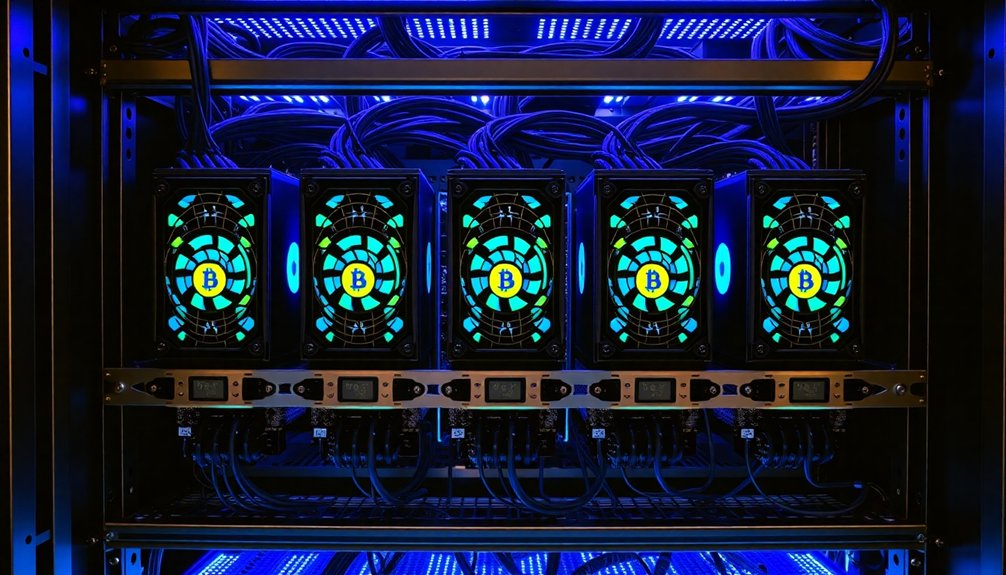
The crypto mining landscape has shifted dramatically heading into 2025, with five standout ASIC miners dominating the Bitcoin scene. Bitmain‘s Antminer S21 XP Hydro leads the pack with a staggering 473 TH/s hashrate and impressive 12 J/TH efficiency. Not bad for a machine that’ll cost you an arm, leg, and possibly a kidney.
Bitcoin mining in 2025: colossal hashrates, kidney-priced machines, and water cooling that makes air look prehistoric.
Meanwhile, its air-cooled sibling, the S21 Pro, delivers a respectable 234 TH/s but falls short on efficiency at 15 J/TH.
Let’s get real about cooling. Water is the new air. Hydro-cooled and immersion systems aren’t just fancy buzzwords anymore—they’re pushing efficiency into the 11-13 J/TH range, compared to air-cooled’s pedestrian 15 J/TH. The MicroBT Whatsminer M66S Immersion proves this point with its 356 TH/s performance while staying submerged. The Whatsminer M60S delivers 170-186 TH/s while consuming 3441 watts of power. Quiet too, unlike those jet-engine air coolers.
Profitability? It exists! Top hydro-cooled models can generate nearly $20 daily at $0.06/kWh electricity costs when Bitcoin hovers around $95K. Air-cooled machines lag behind at $7-10 daily. Simple math. Higher upfront costs for liquid cooling, higher returns. Basic economics, people.
Not everyone’s mining Bitcoin, though. GPU rigs remain king for ASIC-resistant coins like Ravencoin. Scrypt ASICs handle Litecoin and Dogecoin just fine. Niche algorithms have their specialized hardware too.
Home miners aren’t left out in 2025. The Bitaxe Gamma offers a solid entry point without requiring a dedicated power plant. Goldshell’s Byte and AE Max cater to altcoin enthusiasts who don’t want to trip their home’s circuit breakers every time they mine.
Trends are clear. Bigger operations chase water-cooled monsters for maximum hashrate density. Smaller miners stick with air-cooled mid-range models that won’t require remortgaging houses.
Bitmain and MicroBT continue their dominance, releasing new models faster than most people replace their smartphones. The mining game continues—expensive, power-hungry, but occasionally profitable for those who mine one block every 10 minutes.