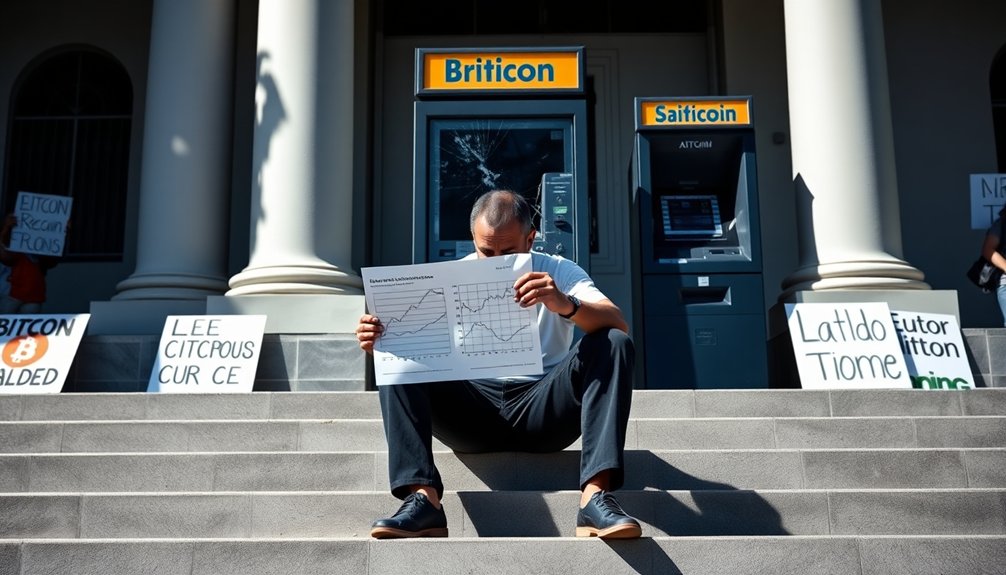

As Bitcoin plunged below the critical $82,000 level, traders watched in horror while over $1.7 billion in positions were liquidated in a brutal 24-hour bloodbath.
The cryptocurrency market turned into a sea of red as Bitcoin crashed more than 10% from late-January highs, briefly dropping below $81,000 before finding temporary footing above $82,300.
Talk about a rough month. January alone saw Bitcoin correct over 20%, with market capitalization shrinking to roughly $1.64 trillion during the worst of the selloff. This pattern aligns with historical data showing 3-5 corrections of similar magnitude typically occur during bull market cycles.
The carnage wasn’t pretty. A staggering 93% of liquidations were long positions – all those optimistic traders getting absolutely wrecked.
Funding rates had stayed positive for weeks, showing everyone was piled into the same bullish trade. Classic market behavior: when everyone’s on one side of the boat, it tips over.
Long-term holders didn’t help matters. These supposedly “diamond hands” started dumping near $84,600 on January 29, with their 30-day net position change dropping to negative 144,684 BTC – the largest monthly outflow in recent memory.
So much for HODLing.
Technical analysts are having a field day. Bitcoin broke below the neckline of a head and shoulders pattern, projecting another potential 12% downside.
That puts $75,000 in the crosshairs. Not exactly the moon mission everyone was expecting.
Institutional money headed for the exits too. Bitcoin ETFs recorded over $1.1 billion in weekly outflows across five consecutive negative days from January 20-26.
BlackRock’s IBIT took the biggest hit with $508.7 million in redemptions. Guess those Wall Street types aren’t as committed as they claimed.
The broader crypto market fared even worse. Ethereum dropped nearly 10% to $2,922, while altcoins amplified the pain – SOL down 8%, AVAX 7.3%.
The entire market basically followed Bitcoin off the cliff. Another day in crypto: fortunes made and lost in hours.
The breakdown of critical on-chain zones around $84,569 and $83,307 signaled significant weakness, as these URPD clusters failed to provide the support many analysts had expected.
Savvy investors who employed sector-based diversification across different crypto categories fared better during the crash, highlighting the importance of not putting all eggs in one basket.